AI process automation is changing how businesses operate, especially for small and medium-sized businesses (SMBs). It combines artificial intelligence with automated workflows to save time, cut costs, and improve efficiency. Here's a quick summary of what you need to know:
- Key Benefits for SMBs:
- Productivity: Up to 40% increase.
- Cost Savings: Reduce operational expenses by 30%.
- Customer Satisfaction: 3.5x higher annual growth.
- Inventory Optimization: Save up to 70% on costs.
- Core AI Technologies:
- Machine Learning: Predict patterns and make data-driven decisions.
- Natural Language Processing (NLP): Enable human-like communication.
- Robotic Process Automation (RPA): Automate repetitive tasks.
- Computer Vision: Analyze visual data like images and videos.
- How to Get Started:
- Identify repetitive, error-prone, or resource-heavy tasks.
- Plan a clear roadmap with realistic goals and budgets.
- Test AI tools in a pilot program before scaling up.
- Popular AI Tools for SMBs:
- Look for tools with integration, security, scalability, and ease of use.
- Example: Shurco.ai offers solutions to cut manual tasks by 40%.
- Real-World Examples:
- Mount Sinai Health System reduced insurance claims errors by 90%.
- Netflix saves $1 billion annually using AI for personalized recommendations.
Implementation Guide for SMBs
Process Selection
Start by identifying processes that offer the greatest potential for improvement with minimal disruption. Research shows that 56% of companies experience a 30% reduction in time spent on tasks after implementing automation tools.
| Process Characteristic | Impact Consideration | Best for Automation |
|---|---|---|
| Repetitive Tasks | High frequency of similar tasks | Routine operations and data entry |
| Error-Prone Processes | Frequent errors that impair quality | Quality control and data management |
| Resource-Intensive Tasks | Significant manual effort required | Administrative and customer service functions |
| Structured Data | Consistent and uniform information | Financial processing and inventory management |
This approach aligns with the priorities of SMBs, focusing on efficiency improvements without causing unnecessary disruptions. In fact, 96% of small and medium-sized businesses that have adopted AI tools report them as effective in streamlining operations.
Step-by-Step Implementation
Here’s a simple three-step guide to help you get started:
- Assessment Phase
Begin by carefully evaluating your current operations.
"AI is relatively new, so start small." – U.S. Small Business Administration
Experiment with accessible AI tools to identify which ones enhance efficiency and align with your growth goals.
- Planning and Preparation
Create a clear roadmap that aligns with your business objectives. Lack of strategy is a common pitfall, with over 50% of AI implementations failing due to poor planning. Key areas to focus on include:- Evaluating your data readiness
- Establishing a realistic budget
- Training your team to use AI tools
- Developing a practical implementation timeline
- Pilot Program
Test your AI solution in a controlled setting. For instance, 1‑800‑Flowers successfully piloted chatbots to enhance customer service and boost sales. Once the pilot is complete, work on integrating the solution seamlessly into your existing systems.
System Integration Methods
After a successful pilot, the next step is technical integration to ensure smooth operations. It's worth noting that 90% of SMB owners face challenges during this phase.
Here’s how to simplify the process:
- Data Centralization: Implement a unified system for managing data. Centralizing data can cut retrieval times by up to 85%.
- Middleware Solutions: Use integration tools to connect your legacy systems with the new AI functionalities.
- Training Programs: Offer comprehensive training to your staff to ensure effective use of the new tools.
"AI doesn't replace the human touch in collaboration; it augments it, making our collective efforts more meaningful and impactful." – Stephen McClelland, ProfileTree's Digital Strategist
Businesses that follow these steps are 12% more likely to see profit growth compared to those that don’t. Companies like Netflix and Stitch Fix have successfully used AI to deliver personalized recommendations and enhance customer experiences, demonstrating the practical benefits of this approach.
AI Tools for SMBs
Shurco.ai Solutions
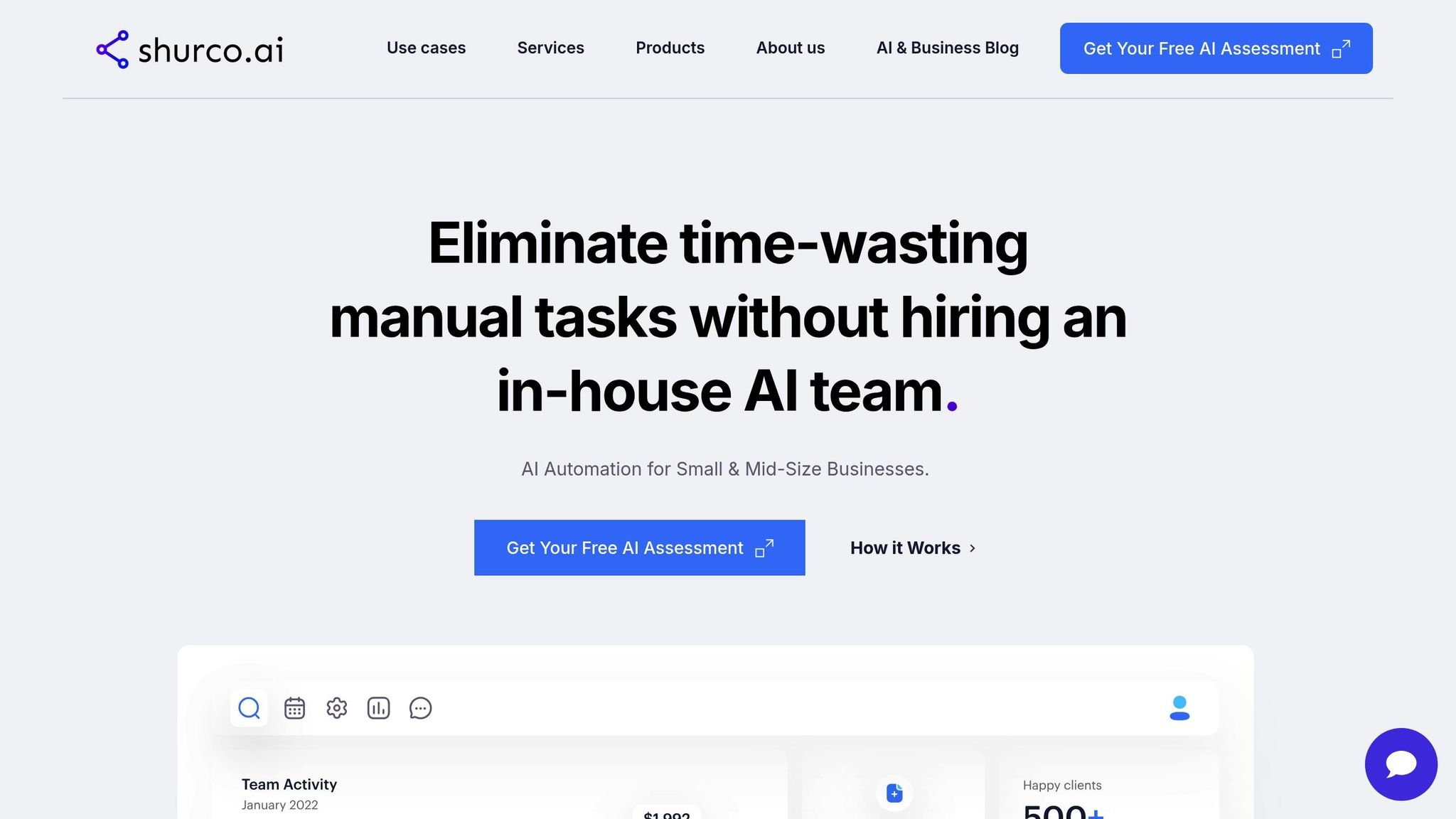
Shurco.ai offers AI-driven automation solutions tailored for small and medium-sized businesses (SMBs). Their platform includes a range of features designed to improve efficiency and reduce costs:
| Feature | Capability | Impact |
|---|---|---|
| AI Agents | Custom process automation | 40% reduction in manual tasks |
| Analytics | Data-driven insights | Smarter decision-making |
| Workflow | System integration | Streamlined operations |
| Conversational AI | Customer engagement | Enhanced experience |
These tools are designed to directly address operational challenges, helping businesses save time and cut expenses.
Must-Have Tool Features
A staggering 90% of commercial leaders plan to increase their use of AI within the next two years. When choosing an AI tool, certain features are essential:
| Feature | Requirements | Value |
|---|---|---|
| Integration | Compatibility with existing software | Smooth workflows |
| Security | Data protection and compliance | Safe and reliable deployment |
| Scalability | Ability to grow with your business | Long-term investment protection |
| User Experience | Easy-to-use interface | Faster adoption by teams |
By focusing on these features, you can ensure the AI tool you select fits seamlessly into your business operations.
Tool Selection Guide
- Define Objectives
"Clean data is the foundation of effective AI implementation" – Rob Martin
Start by identifying the specific goals you want to achieve with AI, whether it's cutting costs, improving customer engagement, or automating repetitive tasks.
- Evaluate Requirements Consider the following factors to ensure the tool meets your needs:
- Compatibility with your current technology stack
- Training and onboarding requirements for your team
- Availability of support and comprehensive documentation
- Total cost of ownership, including implementation and maintenance
- Assess ROI Potential With 92% of businesses using AI reporting reduced operational costs, it's critical to evaluate the potential return on investment. Focus on:
- Clear success metrics
- The tool's proven track record
- Transparent pricing models
- Expected efficiency improvements
Look for a solution that fits into your existing processes without requiring major overhauls. Since 76% of small business owners say AI helps them focus on high-value tasks, selecting the right tool can make a significant difference in maintaining efficient and effective operations.
Real SMB Applications
Office Task Automation
AI simplifies routine office tasks, making them more efficient. A whopping 96% of SMBs using AI tools have reported increased task efficiency. By automating processes like document handling, calendar scheduling, data entry, and invoice management, businesses can cut down on manual errors and focus their energy on more strategic goals. For instance, Shurco.ai's AI agents excel at ensuring precision, compliance, and smooth integration with existing systems. This kind of automation not only streamlines daily operations but also sets the stage for more advanced uses in areas like customer service and specialized industry needs.
Customer Service Tools
AI is also transforming how businesses connect with their customers. AI-powered customer service tools are reshaping interactions by handling routine inquiries and improving engagement. Take TransferGo, for example - they use virtual agents fluent in 11 languages to efficiently manage customer queries and update information.
"By 2025, 80% of customer service and support organizations will be applying generative AI technology in some form to improve agent productivity and customer experience." - Gartner
Spotify has also jumped on board, using real-time translation AI to provide 24/7 support while maintaining an impressive customer satisfaction score of over 90%.
Industry-Specific Uses
AI isn't just about general office tasks; it’s solving unique challenges in specific industries. In manufacturing, Ford employs digital twin technology to oversee production, improving energy use and performance on the assembly line. Over in retail, Walmart uses AI-driven demand forecasting to analyze past sales, predict customer behavior, and fine-tune inventory management. Meanwhile, in electronics, Foxconn integrates AI and computer vision to quickly identify defects in components.
"AI automation is a decisive factor for small and medium-sized enterprises (SMEs) - now it is still a competitive advantage, next year it will be a must, and shortly afterwards a company without AI use will be left out in the cold." - Alexander Stahl
These examples highlight how AI-driven automation is enhancing both efficiency and quality across a range of industries.
sbb-itb-32f4d4f
Measuring Results
Success Metrics
Understanding the impact of AI automation starts with tracking the right metrics. Research shows that 70% of executives prioritize improved KPIs as crucial for business success. To see meaningful changes, it's essential to establish baseline measurements for comparison.
Here are some key areas to focus on:
| Metric Category | Key Performance Indicators |
|---|---|
| Operational Efficiency | Error reduction, processing time, automation rate |
| Financial Impact | Cost savings, revenue growth, profit margins |
| Customer Experience | Satisfaction scores, response times, retention rates |
| Employee Productivity | Time saved, tasks automated, output quality |
For example, a boutique clothing retailer used AI-powered email marketing to track personalized product recommendations. By comparing these campaigns with previous ones, they saw a 34% increase in email conversion rates. Similarly, a small legal practice implemented AI for document analysis, reducing review time by 60%, showcasing how targeted metrics can highlight AI's effectiveness. These metrics also help businesses measure their return on investment (ROI).
ROI Calculation
Calculating ROI is a critical step in justifying the cost of AI automation and planning future investments. Companies that actively measure ROI are 1.7 times more likely to achieve their AI goals. The process involves comparing costs with both direct and indirect benefits.
"The assessment of AI in business isn't just about slashed costs. It's the gateway to unprecedented business intelligence that molds our future strategies."
- Ciaran Connolly, ProfileTree Founder
Here’s a typical cost breakdown for small and medium-sized businesses (SMBs) implementing AI:
| Cost Component | Typical Range |
|---|---|
| AI Software | $15,000 – $50,000 |
| Infrastructure | $3,000 – $10,000/year |
| Training & Onboarding | $4,000 – $10,000 |
| Maintenance & Support | $2,500 – $5,000/month |
A small construction company provides a great example of ROI tracking. By introducing an AI-powered financial forecasting system, they achieved 85% accuracy in three-month predictions. This led to a 40% reduction in short-term borrowing costs. These tangible results demonstrate how ROI calculations can guide smarter business decisions.
Growth and Updates
Once performance metrics and ROI are in place, ongoing updates are key to maintaining success. Regular monitoring and improvements ensure that AI systems remain effective. Research indicates that while the average enterprise-wide AI initiative yields a 5.9% ROI, companies that actively update and refine their systems see a much higher 13% ROI.
"AI isn't just changing the game; it's changing the rules, and businesses need to embrace its potential."
- Stephen McClelland, ProfileTree's Digital Strategist
One example of successful system evolution comes from a small marketing agency. They started with basic content automation, saving 10 hours per week. Over time, they expanded AI use to include social media management and analytics, automating 40% of their workflow within a year. This steady growth highlights how gradual improvements can lead to long-term success.
To ensure ongoing effectiveness, businesses should focus on:
- Regularly updating data to maintain accuracy
- Monitoring performance against benchmarks
- Retraining AI models to adapt to new conditions
- Implementing strong security measures
- Gathering user feedback for continuous refinement
Netflix demonstrates the power of optimization on a larger scale. Their machine-learning-driven content recommendations save the company approximately $1 billion annually in customer retention. While SMBs operate on a smaller scale, applying similar principles of continuous improvement ensures they get the most from their AI investments.
SMB Executives Guide to Leveraging AI Automation
Conclusion
The adoption of AI tools by small businesses has skyrocketed, with usage jumping from 40% in 2023 to an impressive 98% today. This shift isn’t just about keeping up with trends - it’s delivering real results. For example, 82% of businesses report improved operational efficiency, while 77% say AI gives them a competitive edge over larger firms.
The impact of AI is visible across industries. A small bakery, for instance, has automated 70% of its inventory management, while legal firms have slashed appointment scheduling time by 50% with AI systems. These examples highlight how AI is reshaping workflows and delivering measurable benefits.
"AI is no longer an option but a necessity for small businesses looking to scale, improving efficiency, and stay competitive."
- Dr. Leon Herszon, Civil Engineer, Msc, PMP, International Institute for Learning
The numbers speak for themselves:
| Impact Area | Measured Improvement |
|---|---|
| Productivity Increase | Up to 40% |
| Customer Query Resolution | 80% handled by AI chatbots |
| Cost Reduction | 30% savings in operations |
| Time Savings | 240–360 hours annually |
AI’s ability to automate routine tasks is helping businesses trim operational costs by 20–30%. On the customer side, AI-powered CRM systems have boosted satisfaction by 32%, while AI-enhanced advertising has driven 30% higher conversion rates. These results underscore the practical benefits outlined in earlier sections of this guide.
Looking ahead, the momentum for AI adoption shows no signs of slowing. By 2025, 80% of retail companies are expected to integrate AI into their operations. For small businesses, the formula for success is clear: start with manageable applications, measure results, and scale up strategically. By automating repetitive tasks and using AI for smarter decision-making, businesses can free up time and resources to focus on growth.
The explosion of AI usage since 2016 marks a turning point in how businesses operate. For small and medium-sized businesses, embracing AI isn’t just a way to stay relevant - it’s a pathway to thriving in an increasingly digital world. By starting small and scaling smartly, SMBs can position themselves for long-term success, leveraging AI to stay ahead in a competitive landscape.
FAQs
How can SMBs measure ROI from AI-powered process automation effectively?
To figure out the ROI of using AI-powered process automation, small and medium-sized businesses (SMBs) can follow a straightforward plan:
- Define your goals and KPIs: Pinpoint what you want to achieve, whether it’s cutting costs, boosting productivity, or something else. Then, decide on measurable key performance indicators (KPIs) to track your progress.
- Document a starting point: Record your current metrics before introducing automation. This gives you a baseline for comparing results later.
- Account for all costs: Factor in every expense - software, hardware, training, and ongoing maintenance.
- Estimate your gains: Put numbers to the benefits, like money saved, extra revenue generated, or hours freed up by automation.
Once you have these numbers, use this formula to calculate ROI: ROI = (Net Benefits / Total Costs) x 100. This will give you a percentage that reflects your return. Keep an eye on these metrics over time to make sure automation is meeting your objectives, and tweak your approach to get the most out of it.
What challenges do small and mid-size businesses face when adopting AI tools, and how can they address them?
Small and mid-size businesses (SMBs) often face hurdles when trying to adopt AI tools. These challenges typically include tight budgets, limited in-house expertise, and outdated IT infrastructure. Such barriers can slow down adoption and drive up costs, making it harder to integrate AI into daily operations.
To overcome these obstacles, SMBs can take a few practical steps:
- Train employees: Offering training programs can help staff develop the skills and knowledge needed to work with AI tools effectively.
- Start with small projects: Testing AI in specific areas of the business allows for controlled implementation, reducing risks and keeping costs manageable.
- Seek expert advice: Partnering with AI consultants can provide tailored strategies and insights to navigate the complexities of AI adoption.
These approaches can simplify the process, tackle common roadblocks, and help SMBs unlock the potential of AI in their business operations.
What should SMBs consider when choosing an AI tool for automating business processes?
When choosing an AI tool to automate business processes, small and medium-sized businesses (SMBs) should focus on a few essential factors to make sure the solution fits their needs.
Start by pinpointing your business's specific goals and challenges. The tool should align with what you’re trying to achieve and directly address your most pressing issues. Also, think about how well it can grow with your business - SMBs often expand, so you’ll want a tool that can keep up. Seamless integration with your existing systems is another key point. The last thing you want is a tool that disrupts your current workflows.
Cost is always a consideration. Look closely at the pricing model and weigh it against the potential return on investment (ROI). Beyond that, prioritize tools that are easy to use and come with dependable vendor support. A user-friendly interface and solid support can make all the difference in how well your team adopts the tool. By taking these factors into account, SMBs can find an AI solution that simplifies operations and boosts efficiency.